How Long Does Pool Leak Detection Take?
Most detections wrap up the same day — here’s a realistic timeline, what makes it faster or slower, and when you’ll actually have answers.
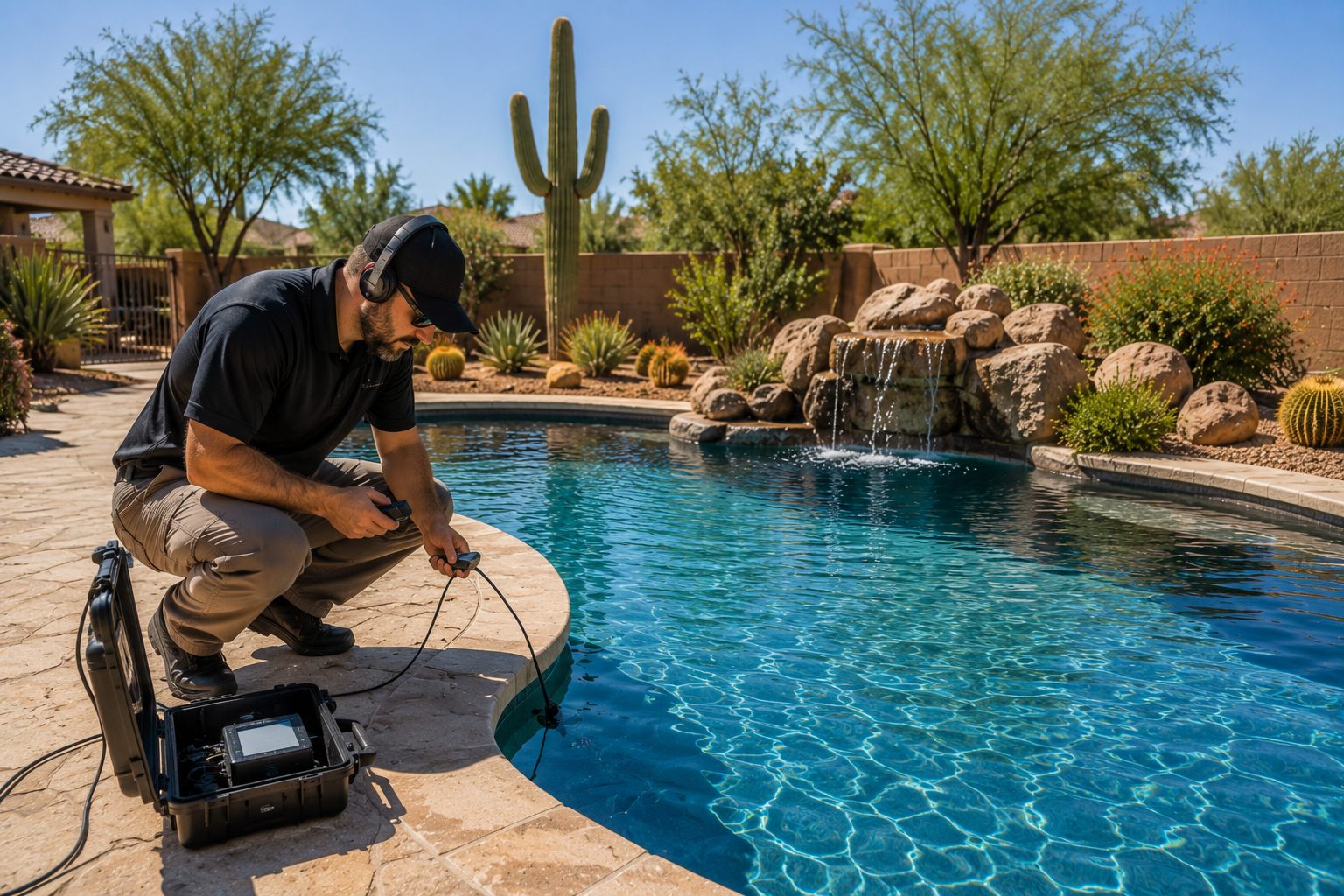
Most professional pool leak detection takes 1 to 3 hours and is finished in a single visit. A straightforward leak at a fitting or the equipment pad can be found in under an hour; a hard-to-reach underground plumbing leak, several leaks at once, or a pool that needs to be lowered can push the job toward half a day or a second trip. In almost every case you get your answer the same day.
If you’re scheduling a service call and wondering how long pool leak detection takes, plan on roughly 1 to 3 hours for a typical residential pool, with the answer in hand before the technician leaves. The exact time depends on where the leak is hiding and how many tests it takes to prove it — but detection is designed to be a same-day process, not a multi-day ordeal.
It helps to know what the technician is actually doing with that time. Detection isn’t one long test; it’s a sequence of shorter ones, each ruling an area in or out (we walk through the full sequence in how pool leak detection works). The clock is really just how long that process of elimination takes on your specific pool.
A Realistic Timeline, Step by Step
Here’s how a typical 1-to-3-hour visit tends to break down. Times overlap and vary, but this gives you a feel for where the hours go:
- Interview & walk-around (15–20 min) — the technician asks about your water loss and inspects the pool, deck, and equipment pad for obvious clues.
- Setting up and isolating (15–30 min) — separating the plumbing, equipment, and structure so each can be tested on its own, and prepping pressure or dye equipment.
- Testing (30–90 min) — the core of the job: pressure-testing lines, dye-testing suspected spots, and using listening equipment to pinpoint the source. This is the part that stretches when a leak is stubborn.
- Pinpointing & marking (10–20 min) — confirming the exact location and marking it so any future repair is targeted.
- Explaining the findings (10–15 min) — walking you through what was found, how serious it is, and what a reasonable repair looks like.
Add it up and a clean job lands near the one-hour mark, while a tricky one uses most of an afternoon. Either way, the visit ends with an answer.
What Makes It Faster or Slower
Two pools with the same symptom can take very different amounts of time. These are the factors that move the needle most:
- Where the leak is. A leak at a skimmer, light, or return fitting is quick to confirm. An underground pressure-side line can take much longer to trace and pinpoint.
- How many leaks there are. Pools often have more than one. Each additional leak adds another round of testing.
- Pool size and construction. More plumbing runs and more fittings mean more to check; a large pool or a complex water feature takes longer than a small, simple one.
- Access to the equipment. A crowded, buried, or awkward equipment pad slows down the isolation step.
- Water clarity and level. Cloudy water makes dye testing harder, and a leak below the waterline may require lowering the pool to reach.
- Recent work. A pool that was just remodeled or re-plumbed can have more than one suspect, which means more to rule out.
None of these are reasons to worry — they’re just why a good technician quotes a range instead of a single number. If your symptoms sound like a classic underground issue, our guide to the signs of a pool leak can help you describe them clearly when you book.
Do You Have to Be There the Whole Time?
Not for the middle of it. Your presence matters most at two points: the interview at the start, so you can describe the water loss, and the explanation at the end, so you understand what was found. The testing in between doesn’t need you hovering — many homeowners hand over the gate code and go about their day. A thorough technician will still walk you (or send you) a clear summary of the results either way.
When Do You Get the Results?
Almost always the same day — usually before the technician packs up. Detection is meant to end with a location and a plain-English explanation, ideally in a short written report you can keep. That’s different from the repair, which is a separate step that happens later and on its own timeline. Knowing the source first is exactly what lets you judge whether a repair quote is fair, which our breakdown of pool leak repair costs gets into.
Detection Time vs. Repair Time
It’s worth separating the two in your head, because people often bundle them and expect a one-day fix:
- Detection — typically 1 to 3 hours, same visit, ends with a diagnosis.
- Repair — scheduled afterward; anything from a quick seal replacement to an excavation, depending on what was found.
Understanding why those are two different jobs — and why you want the first one done before you pay for the second — is the whole point of detection versus repair. When you’d rather have it handled start to finish, a professional pool leak detection service takes it from symptoms to source in that single visit.
Keep reading: How Accurate Is Pool Leak Detection?
Frequently Asked Questions
Can a pool leak be found in one visit?
Usually yes. The large majority of residential leaks are located in a single 1-to-3-hour visit. A second trip is only needed for unusual cases — multiple deep underground leaks, or a structural leak that requires lowering the pool first.
Why is my detection taking longer than a neighbor’s?
Different leaks, different pools. An underground plumbing leak, several leaks at once, a larger pool, or a hard-to-access equipment pad all add testing time compared with a simple fitting leak.
Is a faster detection a worse one?
No. Speed usually reflects an easy-to-find leak and an experienced technician, not a rushed job. What matters is that the source is confirmed with a real test, not guessed at.
How soon after detection can the repair happen?
That’s a separate appointment, scheduled based on what was found and the repair company’s availability. Simple fixes can sometimes happen quickly; excavation-type repairs take longer to plan.
The Bottom Line
Plan on 1 to 3 hours, one visit, and an answer the same day — longer only when the leak is genuinely hard to reach.
Think your pool has a leak? Take our free 60-second assessment to see the most likely source before you ever book a visit.