What Does a Pool Leak Look Like?
Some leaks are obvious, others hide in plain sight. Here’s what a pool leak actually looks like — in the water, around the deck, and at the equipment.
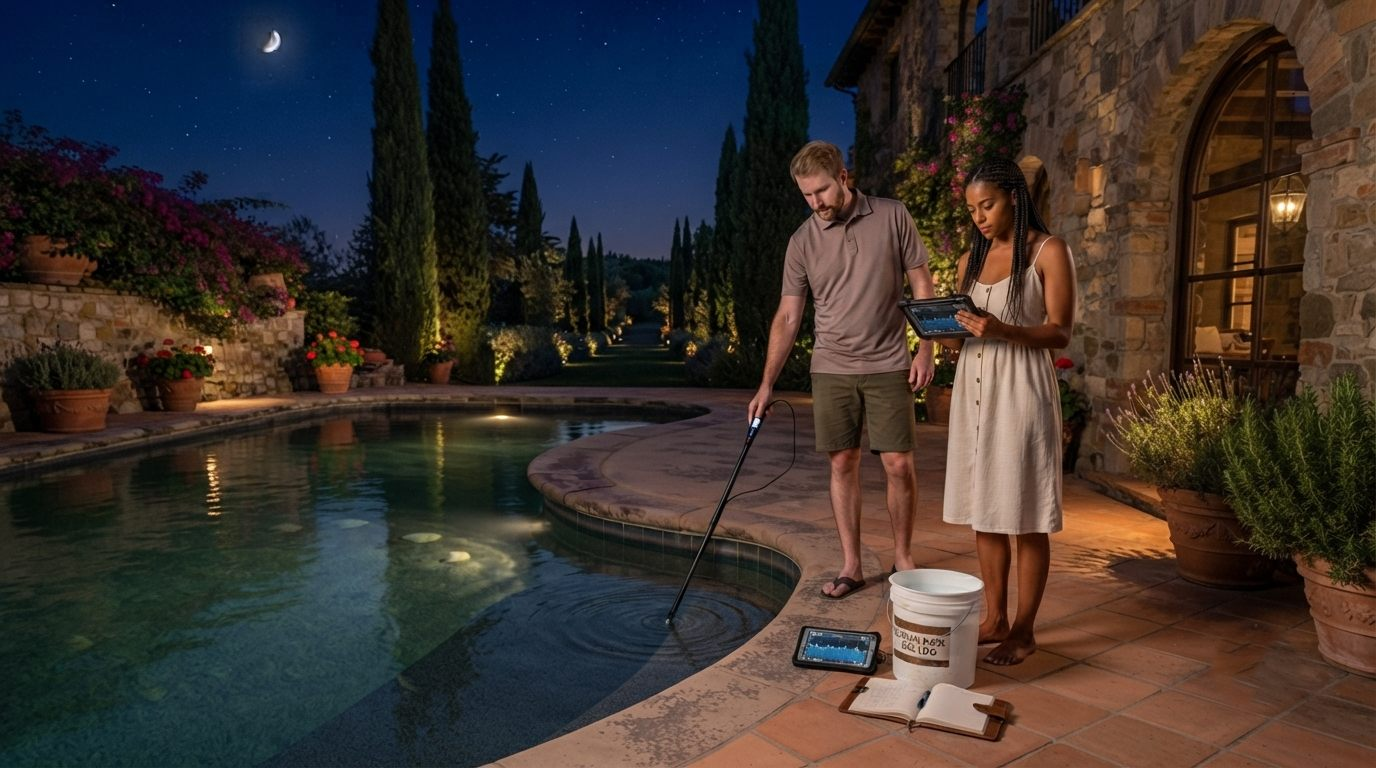
A pool leak usually looks like a steadily dropping water line, plus one or more clues nearby: wet spots or soggy soil around the deck, cracks in the plaster or tile, air bubbles from the return jets, a constantly running auto-fill, or white calcium streaks on the wall. Some leaks — especially underground ones — have almost no visible sign at all, which is why testing matters.
If you’re trying to picture what a pool leak looks like, the honest answer is that it wears a few different faces. The clearest one is a water level that keeps dropping, but the surrounding clues — on the deck, in the water, and at the equipment pad — are what tell you a leak is really there and roughly where it’s hiding.
Below, we’ll walk through what a leak looks like in each of those places. No single sign is proof on its own, but a couple of them together is a strong hint that water is escaping somewhere it shouldn’t.
The Most Common Visual Signs
Most homeowners notice a leak through a handful of recurring signs. The ones that show up most often are:
- A dropping water line — the surface sits lower than usual and keeps falling even after you top it off.
- Wet spots or soggy ground — damp patches on the deck or in the yard that never fully dry, even in the desert heat.
- Cracks in the plaster, tile, or deck — hairline cracks, gaps at the tile line, or a separating expansion joint.
- Air bubbles from the return jets — a sign air is being drawn into the suction-side plumbing where water is escaping.
- An auto-fill that never shuts off — if the automatic filler runs constantly, it’s quietly replacing water that’s leaking out.
- White calcium streaks — chalky mineral deposits below a crack or fitting where water has been seeping and evaporating.
These map closely to the broader signs your pool has a leak — the difference here is what each one actually looks like when you’re standing at the pool.
What a Leak Looks Like Around the Deck and Yard
Some of the most telling signs aren’t in the pool at all — they’re in the ground around it. Water escaping from the shell or underground plumbing has to go somewhere, and it often surfaces nearby.
Look for damp or muddy areas that linger, unusually lush or green patches of grass fed by the escaping water, or spongy, sinking sections of deck.
In more advanced cases you may see the deck, coping, or nearby pavers cracking or tilting as the soil beneath them erodes and settles. Those yard-level clues are covered in depth in what wet spots around your pool mean.
What a Leak Looks Like In the Water
Inside the pool, a leak changes more than just the water level. A few things to watch for:
- The level stalls at a certain height — if the water drops and then holds at the skimmer, a return, or the light, the leak is likely right at that spot.
- Bubbles at the returns — steady streams of small bubbles when the pump runs point to a suction-side leak pulling in air.
- Cloudy or unbalanced water — constant refilling dilutes your chemicals, so the water can look hazy or turn green faster than it should.
- Debris gathering at one spot — fine debris sometimes drifts toward a crack or drain where water is being pulled through.
These water-level patterns are also a diagnostic map: where the level settles narrows down the source before anyone runs a test.
What a Leak Looks Like at the Equipment Pad
The equipment pad is worth a close look, because a surprising number of “pool” leaks are actually here — and they’re cheaper to fix.
With the system running, check for drips or a wet ring under the pump, filter, heater, and valves, corrosion or mineral crust on fittings, or a small puddle that keeps returning after you dry it.
A leak at the pad often looks like nothing more than a persistent damp spot on the concrete, so it’s easy to miss.
When a Leak Has Almost No Look at All
Here’s the catch: some leaks are nearly invisible. An underground plumbing leak can drain water straight into the soil with no wet spot, no crack, and no bubbles — the only sign is the falling water level and a rising bill.
That’s exactly why you can’t always trust your eyes alone. If your pool is clearly losing water but nothing looks wrong, that absence of visible clues actually points toward a buried line, which needs pressure testing to find.
It’s the same reason a bucket test and, ultimately, professional detection matter — more on the difference in leak versus evaporation.
Using the “Look” to Point Toward the Source
Put together, the visual signs do more than confirm a leak — they hint at where it is. Cracks and calcium streaks suggest a structural leak; bubbles from the returns suggest suction-side plumbing; a wet, sinking deck suggests underground loss; and a damp equipment pad suggests a fitting or seal.
None of this replaces testing, but it gives you — and a technician — a huge head start. When several signs line up, a professional pool leak detection service can confirm the exact source in a single visit, and our full pool leak symptoms guide ties all the clues together.
Keep reading: The First Signs of a Pool Leak Most Homeowners Miss
Frequently Asked Questions
Can a pool leak be invisible?
Yes. Underground plumbing leaks often have no visible sign at all — no wet spot, no crack — because the water drains straight into the soil. The falling water level may be the only clue, which is why testing beats eyeballing it.
What does a structural pool leak look like?
Usually a crack in the plaster, shell, or tile line, sometimes with a white calcium streak trailing below it where water has seeped and dried. The water level often stalls at the height of the crack.
Do air bubbles always mean a leak?
Not always, but persistent bubbles from the return jets while the pump runs are a classic sign of a suction-side leak drawing in air. It’s worth checking the pump lid and fittings, then testing if they continue.
Is a wet deck always from a pool leak?
No — splash-out, irrigation, and rain can all wet a deck. But a spot that stays damp when everything else is dry, especially in Arizona’s climate, is worth investigating as a possible leak.
How can I tell a leak from evaporation just by looking?
You often can’t by sight alone, since both drop the water level. A bucket test settles it by measuring evaporation and your pool at the same time — any extra loss is a leak.
The Bottom Line
A pool leak looks like a dropping water line plus nearby clues — wet ground, cracks, bubbles, calcium, or a running auto-fill — but some leaks show almost nothing, so confirm with a test.
Seeing one or more of these signs? Take our free 60-second assessment to see the most likely source before you call anyone.